Research
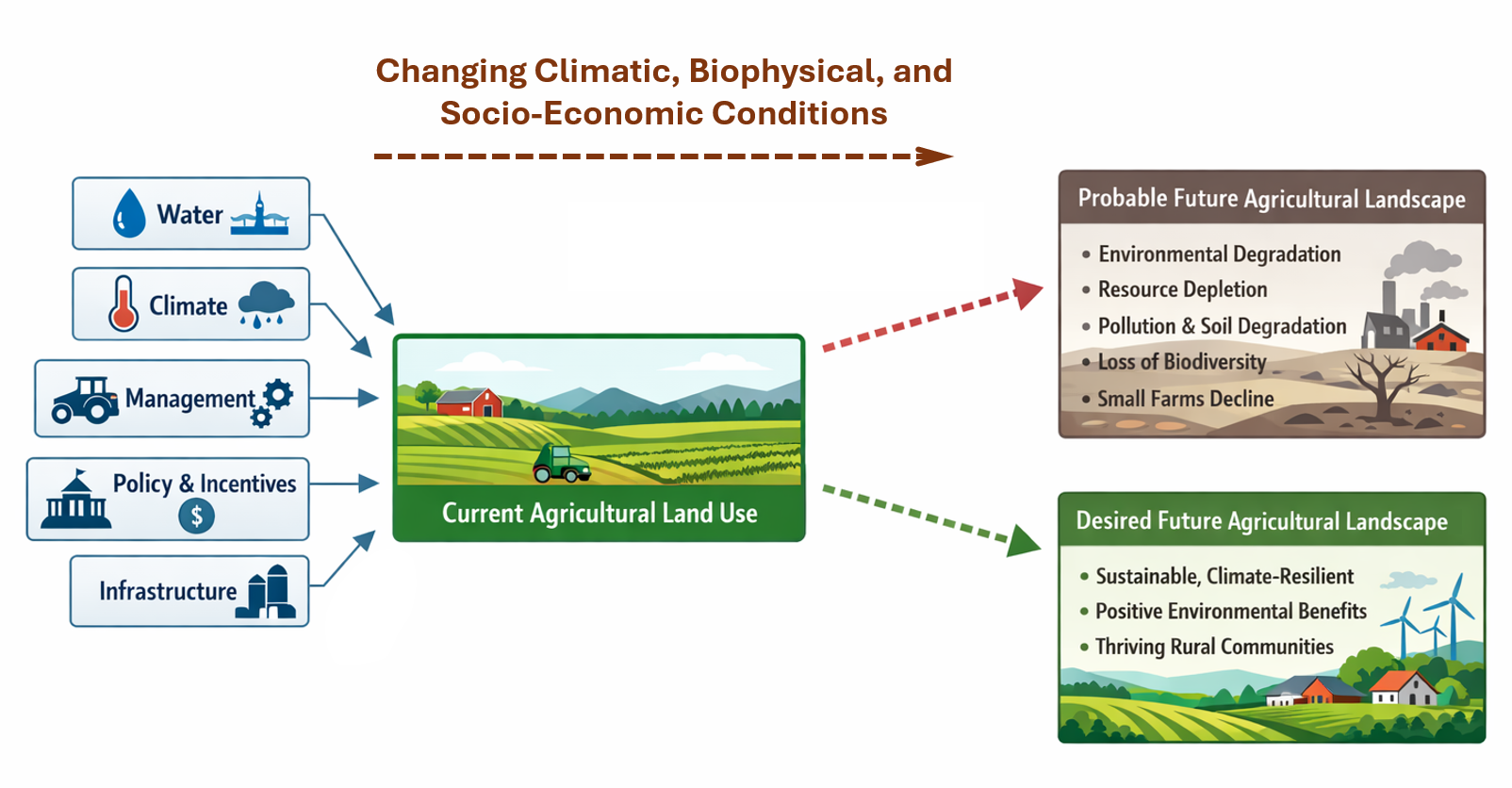
I am interested in understanding agricultural and food systems and their connections with water resources, farming practices, governmental policies, growing food demands, regional biodiversity, and rural livelihoods. These connections are complex in real-world systems and are often bidirectional, with human decisions shaping environmental outcomes and environmental constraints influencing human choices.
Through my research, I generate insights that help assess the environmental implications of agriculture and the long-term sustainability of agri-food systems. As global food demand continues to increase, pressure on food production systems will intensify, and future agri-food systems are likely to change. Ensuring that these transitions are sustainable requires informed decision-making.
My work aims to identify and evaluate desirable agricultural transitions that are climate-resilient, environmentally sustainable, and supportive of smallholder and farming communities. Methodologically, I use large-scale hydrological models, statistical methods, and machine-learning-based approaches to understand how climatic and anthropogenic drivers influence food and water systems. Below is a conceptual overview of my research on agri-food system transitions, human-environment interactions, and sustainable resource use.